


.jpg)
Overview
A new layer has emerged
For decades, enterprise technology stacks have been built on the same architecture. Infrastructure at the base. Data on top of that. Software above that. Each layer does its job, and together they run the organization.
AI doesn't replace any of those layers. It adds a new one.
The intelligence layer sits above your existing stack and interacts with all of it. It's made up of agents, models, governed memory, and orchestration. And unlike the software tools underneath it, this layer doesn't just execute commands. It reasons, retrieves, decides, and acts.
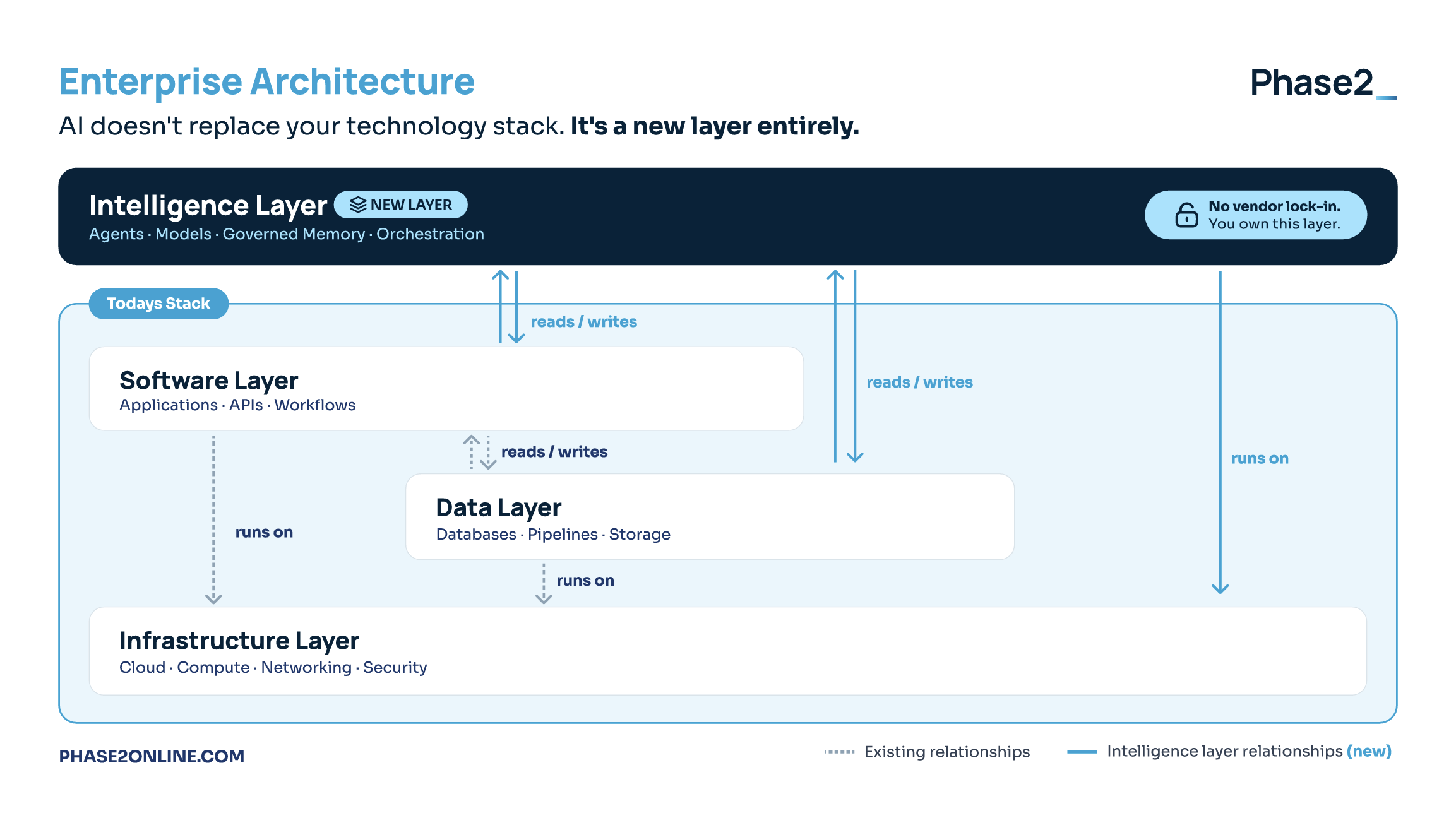
That's a fundamentally different kind of capability. And it changes how you should think about building it.
Renting AI vs. owning it
Productivity tools like Copilot and Glean are useful. They're also rented. They sit on someone else's infrastructure, follow someone else's roadmap, and don't carry any of your organization's specific knowledge, context, or processes with them. They're the same for your business as they are for your competitor's.
The intelligence layer is different. When built correctly, it's trained on your data, governed by your policies, and aligned to your workflows. It knows your organization. That's not something you rent. That's something you must own.
The distinction matters because data powers your software, but knowledge powers your intelligence. Your organization's accumulated expertise, its policies and procedures, its institutional memory: that's the asset that makes an intelligence layer valuable. When it's yours, it compounds. When it's rented, it doesn't.
What "owning" actually means
Owning your intelligence layer doesn't mean building AI for the sake of it. It means making deliberate decisions about where AI earns its place in your operations and building the infrastructure to support it safely.
That includes security (the AI only accesses what it's authorized to access), governance (it operates within your compliance and ethical boundaries), reliability (consistent, auditable outputs), and predictability (human oversight where it matters, automation where it's earned).
It also means no vendor lock-in. The model landscape is shifting fast. An intelligence layer that ties you to one provider is a liability. One built on multi-model architecture, with your knowledge and governance sitting above any single model, gives you durability.
The window for advantage
The organizations that build their intelligence layers now will have a meaningful head start because the knowledge, governance structures, and operational discipline they build take time to develop and can't be easily copied.
Most organizations will bolt AI tools onto existing processes and wonder why the results are underwhelming. A smaller number will do something fundamentally different: they'll redesign their operations around AI as a first-class participant and build the infrastructure to support it.
The difference between those two groups will be significant, and it will show up quickly.
The question worth asking
Before evaluating another AI tool, ask your team: what AI capability should we own? Where does institutional knowledge create value that a generic tool can't replicate? Where do decisions get made that require governance, not just a model endpoint?
Those answers point to your intelligence layer. And that's where the real work begins.

.png)
.png)